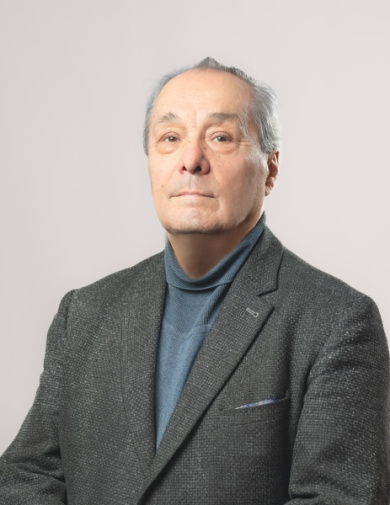
Laureate of the State M. I. Glinka Prize, winner of international and All‑Russian competitions, Full Member of the Petrovsky Academy of Sciences and Arts (St. Petersburg), Professor.
He was born in 1943 in Moscow.
In 1962 he graduated from the Music College at the Moscow State Conservatory, where he studied composition with A. I. Piryumov and cello with A. N. Yegorov. In 1967 he graduated from the Moscow Tchaikovsky State Conservatory, where he studied composition with Aram I. Khachaturian, and in 1969 he completed his postgraduate studies under Khachaturian’s supervision.
Since 1967 K. Ye. Volkov has worked as an editor for music theatre and symphonic music at the publishing house Soviet Composer.
Since 1969 he has taught in the Department of Theory and Composition at the Gnesin State Music and Pedagogical Institute, and since 1970 also in the Instrumentation Department of the Moscow Tchaikovsky State Conservatory.
From 1975 to 1989 he was elected to the Secretariat of the Union of Composers of Russia and served as First Deputy Chair of the Union’s Board.
In 1989 he was invited by Rector S. M. Kolobkov to head the Department of Composition and Instrumentation at the Gnesin State Music and Pedagogical Institute.
Selected works:
- Opera Muzhitsky skaz (Peasant Tale), Moscow Television, 1972; staged premiere in Berlin and Dessau, 1975;
- Opera The Rider Galloping Ahead, Natalia Sats Children’s Musical Theatre, 1977;
- Opera Live and Remember, 1979–1984, two versions (Hanns Eisler Academy of Music and television in Berlin, Eisleben, Dessau; Chamber Musical Theatre of Boris Pokrovsky in Moscow);
- Opera Terkyn, Terkyn…, 1984;
- Opera The Passions of Lieutenant Soshin (The Sad Detective), 1986;
- Ballet Doctor Zhivago, 1994–1996 (productions in Des Moines, USA, and Varna, Bulgaria);
- Two symphonies: for mezzo‑soprano and orchestra to Russian folk texts (1969) and In Memory of N. Ya. Myaskovsky (1971);
- Symphonietta for orchestra and two bayans (1965);
- Overture Festival (1968);
- Concerto for large symphony orchestra (1975);
- Concerto for violin and cello (1967);
- Concerto for bayan (1972);
- Double Concerto for soprano, cello, and small symphony orchestra (1973);
- Concerto‑Tableau Andrei Rublev for wind quintet and orchestra (1970);
- Vladimir Triptych for chamber orchestra (1982);
- Concerto for harp quartet and small symphony orchestra (1988);
- Concerto for domra and small symphony orchestra (2002);
- Concerto‑Suite for Orchestra of Russian Folk Instruments, The Swan Floats By (1972);
- Trilogy of Suites about Moscow – Russian Country‑House Waltzes, The Houses of Moscow, and The Boulevards of Moscow (2005);
- Ladoga, a cycle for voice and orchestra of Russian folk instruments, text by V. Semernin (1971);
- Sonata‑Diptych for cello, organ, and harpsichord (1971);
- Second Sonata for cello and organ (2003);
- Suite for harp quartet Russian Cities (1975);
- Sonatina for piano (1967);
- Sonatina‑Impromptu for violin and piano, dedicated to Igor Oistrakh (1971);
- Five piano sonatas (1970–2007); the Fourth and Fifth Sonatas won First and Second Prizes at the Sergei Prokofiev International Competition and are included on CD in the Anthology of Piano Sonatas by Russian and Soviet Composers of the Twentieth and Twenty‑First Centuries;
- Four sonatas for solo bayan, published by Muzyka in the Anthology of Bayan Literature edited by Friedrich Lips (1995–2014);
- Four organ sonatas (1998–2015);
- Sonata for alto domra and piano (2015);
- Skladien, a diptych for bayan and organ (2015);
- Mother Maria, a duo‑sonata for domra and bayan (2017);
- Mystery Avvakum, based on The Life of Archpriest Avvakum;
- Cantatas on poems by Nikolai Rubtsov: My Quiet Homeland, I Shall Run Up the Hill, The Banner from Kulikovo (2017);
- Cantata SLOVO on lines from The Tale of Igor’s Campaign;
- Secular choral works on texts by Russian and foreign poets (1990–2017);
- Choral works on canonical texts of the Russian Orthodox Church (1990–2017).