
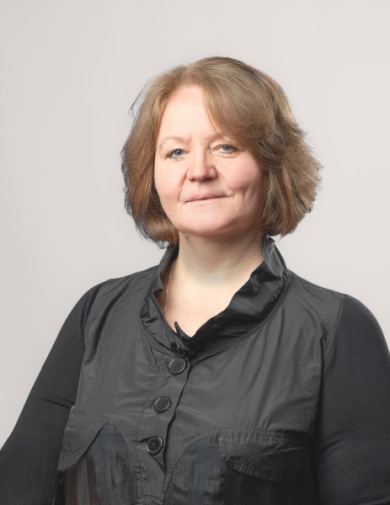
Svetlana Yu. Vlasova
Associate Professor of Ethnomusicology Department
Biography
She was born in 1966 in Novosibirsk.
In 1986 she graduated with distinction in music theory from the Novosibirsk College of Music, and in 1995 she completed, also with distinction, her studies at the Faculty of Theory and Composition of the Saint Petersburg Rimsky‑Korsakov State Conservatory, specialising in ethnomusicology (supervisors: Associate Professor Irina B. Teplova and Professor Anatoly M. Mekhnetsov).
Since the mid‑1980s she has been engaged in research, methodological, and creative work and is an active participant in Russia’s contemporary folk movement. From 1995 to 2009 she worked as a leading research fellow in the Department of Musical Folklore at the State Republican Centre of Russian Folklore, where she prepared musical‑ethnographic materials for publication, wrote articles, systematised and catalogued audio and video collections, and took part in international and Russian conferences.
Since 2012 she has been a Senior Lecturer in the Department of Applied Musical Arts of the Faculty of History, Theory, and Composition, and since 2018 an Associate Professor in the Department of Ethnomusicology. She teaches folk ensemble and subjects related to students’ performance and fieldwork practice.
The geography of Svetlana Yu. Vlasova’s musical‑ethnographic expeditions covers numerous regions of Russia (Bryansk, Pskov, Novgorod, Tver, Vologda, Novosibirsk, Kurgan, Ryazan, Vladimir, Belgorod, Kursk, and Volgograd) as well as adjacent territories in Ukraine (Sumy and Kharkiv regions). She is currently engaged in field studies of the musical‑folklore traditions of southern and western Russia.
Her scholarly and practical (performance and later choral‑conducting) activity began in 1984 in the Siberian Song Ensemble of the Novosibirsk Regional Scientific and Methodological Centre, under the direction of Valery V. Asanov, composer, folklorist, member of the Union of Composers of Russia, and Vice‑President of the Russian Folklore Union. For more than fifteen years she was a member of the Moscow ensemble Narodny prazdnik, one of the first groups to gain wide recognition abroad and to establish in contemporary Russia the priority of the folk‑ethnographic approach to authentic musical materials.
Svetlana Yu. Vlasova has taken part in various scholarly and artistic projects abroad, including:
- The scholarly‑creative laboratory and international conference «Polyphonies populaires russes» (France);
- International festivals of folk and contemporary music in Paris and on the island of Corsica (France), in Fribourg (Switzerland), in San Francisco and at Fort Ross Museum (USA), in Lublin and Warsaw (Poland), in Riga (Latvia), and in Vilnius and Klaipeda (Lithuania);
- Scholarly‑practical conferences on contemporary folk performance organised by the music foundation Muzyka Kresów (Poland).
For fifteen years Svetlana Yu. Vlasova has collaborated with various Polish cultural organisations that develop and implement methods for practically engaging with the traditional musical cultures of European peoples, including:
- Fundacja Muzyka Kresów;
- Stowarzyszenie Panorama Kultur;
- Ośrodek Międzykulturowych Inicjatyw Twórczych Rozdroża;
- Fundacja Wszystkie Mazurki Świata.
She has led workshops and practical seminars within major international projects established by these Polish organisations, including classes at the Międzynarodowa Letnia Szkoła Muzyki Tradycyjnej (International Summer School of Traditional Music) and masterclasses as part of the creative programme of the Sputnik nad Polską Russian Film Festival.
In Russia she has given masterclasses and seminars on methods of working with folk‑ethnographic ensembles in Vologda, Barnaul, Kazan, Perm, Yekaterinburg, Omsk, Tver, Moscow, and Surgut.
Her organisational, artistic, and expert work includes participation in the preparation and running of the All‑Russian Scholarly‑Practical Forum «Living Tradition» in Moscow and membership of juries for various festivals, including:
- the Moscow Open Festival of Children’s, Youth, and Student Folk Ensembles Solntsevorot;
- the Regional Festival of Children’s Folk Ensembles Nasledniki traditsiy in Vologda;
- the Open Ethno‑Festival‑Competition Pesn zemli and the All‑Russian Festival‑Competition of Music and Dance Traditsiya (Moscow);
- the International Folklore Festival Mayskie assamblei (Moscow, Gnesin Russian Academy of Music).
She is currently Artistic Director of the Folk Ensemble of the Gnesin Russian Academy of Music and of the Russian traditional music ensemble Romoda.
Romoda is a professional ensemble working in the folk‑ethnographic tradition that is highly relevant in contemporary Russia, presenting authentic ethnic traditions at a new historical stage. The ensemble has repeatedly become a laureate of folk music festivals in Russia (Moscow, Vologda, Saint Petersburg, Yekaterinburg, Omsk, Novosibirsk) and abroad (the Baltic states, Poland, Germany). The Folk Ensemble of the Gnesin Russian Academy of Music consists of undergraduate and postgraduate students specialising in ethnomusicology.
Since its foundation in 2012 the ensemble has repeatedly become a diploma‑winner and laureate of international folklore forums in Russia and abroad, including:
- the festival‑review of folk ensembles of higher and secondary specialised education institutions Vselistvenny venok in Saint Petersburg (twice, in the category «Mastery of Authentic Performance of Folk Music»);
- the festival Starejshie pesni Evropy in Lublin (category «Contemporary Performance of Authentic Music»);
- the festival in memory of Professor Anna V. Rudneva in Moscow (diploma of the Moscow Tchaikovsky State Conservatory);
- the Ethnoculture Festival in Minsk (diploma of the Belarusian State Academy of Music), among others.
Diplomas and letters of appreciation awarded to the Folk Ensemble of the Gnesin Russian Academy of Music at creative events include:
- Second Prize diploma at the International Festival‑Review of Folk Ensembles of Higher and Secondary Specialised Education Institutions Vselistvenny venok in the category «Mastery of Authentic Performance of Folk Music» (Saint Petersburg State Conservatory, 27–29 May 2013);
- A diploma of the International Festival‑Review Vselistvenny venok for its contribution to the preservation of folk musical traditions and its high performance level;
- First Prize diploma at the 14th International Festival Starejshie pesni Evropy in the category «Contemporary Performance of Authentic Music» in Lublin (Ośrodek Międzykulturowych Inicjatyw Twórczych Rozdroża, Poland, 3–6 October 2013);
- Laureate diploma at the International Festival in Memory of Professor Anna V. Rudneva (Moscow State Conservatory, 7–10 November 2013);
- Participant diploma at the International Ethnoculture Festival Musical Culture of Belarus: Traditions of Oral and Written Creativity (Minsk, 9–11 November 2014);
- Third‑year student Veronika Nikeshicheva – First Prize laureate of the All‑Russian Festival of Music and Dance Traditsiya (Moscow, 2–4 October 2014) in the solo categories «Traditional Instruments» and «Traditional Singing»;
- Third‑year student Ekaterina Nozdrina – First Prize laureate of the same festival in the solo categories «Traditional Instruments» and «Traditional Singing»;
- Laureate diploma at the 9th International Social and Cultural Forum Living Tradition (Russian Folklore Union, State Centre of Russian Folklore, 12–16 November 2014);
- Laureate diploma at the International Interactive Festival Folk‑progressive (Moscow, 6–7 February 2015);
- Fourth‑year student Ekaterina Nozdrina – Grand Prix at the International Festival of Ethnic Music and Crafts Mir Sibiri (Krasnoyarsk Territory, 8–12 July 2015);
- Diploma of the International Folklore Festival Pokrovskie kolokola (Vilnius, Lithuania, 9–11 November 2015);
- Second Prize diploma at the International Festival‑Review Vselistvenny venok in the category «Mastery of Authentic Performance of Folk Music» (Saint Petersburg State Conservatory, 16–19 May 2016);
- Letter of appreciation from the Organising Committee of the All‑Russian Festival of Music and Dance Traditsiya (Moscow, 30 May – 4 June 2016) for participation in the gala concert and interactive events;
- Laureate diploma at the 11th International Social and Cultural Forum Living Tradition (Russian Folklore Union, State Centre of Russian Folklore, 12–15 November 2016).
Svetlana Yu. Vlasova has also received numerous letters of appreciation from Russian and foreign cultural and educational institutions for conducting workshops and masterclasses, participating in festivals, serving on juries, and other activities, including:
- February 2012 – diploma from Emil Majuk, President of the creative association Panorama Kultur (Warsaw);
- February 2012 – letter of appreciation from Andrei A. Potemkin, Head of the Rossotrudnichestvo representative office in Poland (Warsaw);
- November 2012 – letter of appreciation from Emil Majuk, President of Panorama Kultur (Warsaw);
- April 2013 – letter of appreciation from Vladimir P. Kazantsev, Director of the Altai State House of Folk Art (Barnaul);
- April 2013 – certificate from Vladimir V. Nakharenko, Head of the Administration of Pervomayskoye (Moscow);
- May 2013 – letter of appreciation from Janusz Prusinowski, Artistic Director of the festival Wszystkie Mazurki Świata (Warsaw);
- May 2013 – letter of appreciation from Alexander P. Leshukov, Rector of the Vologda State Pedagogical University;
- October 2013 – letter of appreciation from Sergey V. Antufyev, Head of the Rossotrudnichestvo representative office in Poland (Warsaw);
- October 2013 – letter of appreciation from Jagna Knittel, Director of Panorama Kultur (Warsaw);
- October 2013 – letter of appreciation from Jan Bernad, Director of the Centre Rozdroża (Lublin, Poland);
- October 2013 – certificate from Bartłomiej Drozd, President of the Muzyka Kresów foundation;
- September 2014 – certificate from Konstantin A. Onufrienko, Director of the Tver Regional Training and Methodological Centre for Educational Institutions of Culture and Art;
- November 2014 – letter of appreciation from Vladimir P. Lapukhin, Minister of Culture of the Omsk Region;
- December 2015 – letter of appreciation from the Director of the Russian Folklore Centre MBUK Kazan (Tatarstan);
- January 2016 – letter of appreciation from Tatiana M. Sannikova, Director General of the Perm House of Folk Art Guberniya;
- July 2016 – letter of appreciation from Vytautas Grubliauskas, Mayor of Klaipeda (Lithuania);
- November 2016 – letter of appreciation from Natalia N. Gilyarova, Chair of the Russian Folklore Union and Professor at the Moscow Tchaikovsky State Conservatory (Moscow).
Publications:
- «Traditional Culture of the Murom Region», ed. Alexander S. Kargin, vols. 1–2, Moscow, 2008, vol. 2, section «Musical Folklore», pp. 7–383;
- «Principles of Mastering the Vocal Style of a Local Tradition», conference abstract in Wspołczesne problemy śpiewu tradycyjnego (Contemporary Problems of Traditional Singing), Lublin, Fundacja Muzyka Kresów, July 2003, pp. 36–38;
- «Traditional Singing: Musical Logic and Vocal Technique», Vestnik Rossiyskogo folklornogo soyuza, 2003, no. 4, pp. 17–23; 2004, no. 1, pp. 26–50;
- «Traditional Singing and Its Adaptive Potential», scholarly almanac Traditsionnaya kultura, 2004, no. 3, pp. 72–83;
- «Solntsevorot», Vestnik Rossiyskogo folklornogo soyuza, 2008, no. 2, pp. 42–53;
- «The Ethnocultural Component in Modern School Education», in Folklore and Youth: Involving Children and Young People in National Cultural Traditions, collected scholarly articles, comp. Svetlana R. Kuleva, Vologda, 2011, pp. 71–85;
- «Russian Lullabies of Stable Structure», Voprosy etnomuzykologii, 2012, no. 1, pp. 55–70.
Discography:
- Youth Folk Ensembles of Moscow Sing: Narodny prazdnik Ensemble, Songs of Southern Russia, Moscow, Melodiya, 1988;
- Polyphonies populaires russes, Ensemble Pesen Zemli (CD accompanying the book), eds. Simha Arom and Christian Meyer, Collection Rencontres à Royaumont, 1993, France, audio CD supplement to the proceedings of the international scholarly conference «Russian Folk Polyphony», Royaumont, 1993;
- Zhivaya traditsiya, All‑Russian Scholarly‑Practical Forum, DVD of the Russian Folklore Union, Moscow, 2006.
The Gnesin Russian Academy of Music uses the «Digital Culture» subsystem to collect statistics. We make our website better and more efficient for users based on this data. By continuing to use this site, you agree to the use of cookies and data processing in accordance with the site's Policy on the processing and protection of personal data.