
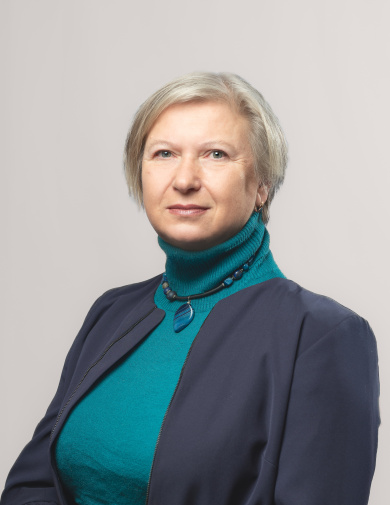
Irina P. Susidko
Head of Analytical Musicology Department; Editor‑in‑Chief of the journal «Contemporary Problems of Musicology»
Biography
Born in 1958 in Dnepropetrovsk (Ukraine).
In 1983 she graduated from the Gnesin State Music and Pedagogical Institute, where her teachers included R. N. Berberov, I. A. Givental, B. B. Efimenkova, and N. S. Gulyanitskaya. After completing postgraduate studies (class of F. G. Arkhamanov) she defended her Candidate of Arts dissertation «The Musical Dramas of C. W. Gluck in the Context of Enlightenment Culture» at the N. A. Rimsky‑Korsakov Leningrad Conservatoire in 1988.
In 2000 she defended her Doctor of Arts dissertation «Opera seria: Genesis and Poetics of the Genre» at the State Institute for Art Studies in Moscow.
Since 1984 she has taught at the Gnesin Institute–Academy, becoming Professor in 2003 and, from 2009, Head of the Department of Analytical Musicology. I. P. Susidko teaches courses in musical form and the methodology of teaching professional disciplines, supervises diploma and dissertation projects, and has developed new courses in opera and ballet theatre history, contemporary musical theatre, opera libretto studies, and music advertising.
Under her supervision 37 diploma projects and 17 Candidate dissertations have been completed.
Among her students are the following Candidates of Art History:
- N. Pilipenko, Associate Professor in the Department of Analytical Musicology and Academic Secretary of the Dissertation Council;
- T. Oganova, Chair of the Music Literature Examination Board and Head of the Information‑Methodology Department at the Gnesin Music College;
- L. Aristarkhova, presenter and programme author for the «Kultura» TV channel, Associate Professor in the Departments of Analytical Musicology and Applied Musical Arts at the Gnesin Academy;
- O. Yemtsova, senior editor at the radio stations «Kultura» and «Zvezda»;
- Ta Quang Dong, Vice‑Rector of the Hanoi Conservatoire;
- E. Permyakova, Associate Professor at the P. Serebryakov Volgograd Conservatoire and Director of the children’s music theatre «Sady Si‑mi‑re‑mi‑do» in Volgograd;
- T. Shchukina, Associate Professor at the P. Serebryakov Volgograd Conservatoire;
- V. Esakov, Head of the Chamber Ensemble Department at the A. G. Schnittke Moscow State Institute of Music;
- M. Khvostikov, soloist of the Munich Philharmonic Orchestra and laureate of international competitions;
- O. Yemtsova, senior editor at Radio «Zvezda»;
- R. Nagin, Head of Public Relations at the Helikon‑Opera Theatre;
- T. Kovalenko, lecturer at the Music College in Pyatigorsk;
- D. Nagina, lecturer in the Department of Analytical Musicology at the Gnesin Academy;
- M. Fichtenholz, well‑known journalist, critic, and opera producer.
In 1999–2000 and 2001 I. P. Susidko taught at the Musicology Faculty of the University of Münster, offering courses on Italian opera and Russian music. She has received three international research grants (Austria, Germany, Italy) and four grants from the Russian Humanities Research Foundation.
Since 2000 she has been a Leading Research Fellow at the State Institute for Art Studies, a member of the editorial boards of several scholarly journals, and a member of the Academic Council of the Russian Society for Music Theory.
From 2009 to 2014 she also served as Professor at the Moscow City Pedagogical University.
Her research interests include the history and theory of Western music from the seventeenth to the twentieth centuries, musical form and analysis, opera‑theatre history, Russian music in the context of European culture, and music pedagogy.
She has published more than ninety scholarly articles, four monographs, and three textbooks, including:
- «The Italian Opera of the Eighteenth Century», vols. 1 and 2, Moscow, 1998 and 2004;
- «Mozart and His Time», Moscow, 2008;
- «Musical Theatre of the Eighteenth Century», Moscow, 2013.
For «The Italian Opera of the Eighteenth Century» she received a commendation from the Russian Ministry of Culture.
She has frequently presented papers at international conferences in Russia and abroad and has curated a number of all‑Russian and international conferences. She led the Student Scholarly Society at the Gnesin Academy for many years, served as Academic Secretary of its Dissertation Council from its foundation, and now chairs that Council while also sitting on the Dissertation Council of the State Institute for Art Studies and the Scientific Committee of the Russian Society for Music Theory.
Since 2017 she has been Editor‑in‑Chief of the Gnesin Academy’s online journal «Contemporary Musicology», and a member of the editorial boards of the journals «Starinnaya muzyka» and «Uchenyye zapiski RАМ imeni Gnesinykh».
In 2020 I. P. Susidko received an official Letter of Appreciation from the Minister of Culture of the Russian Federation and an Honorary Diploma from the Ministry of Science and Higher Education of the Russian Federation.
Details of selected publications and conference activity:
Monographs:
- Lutsker P. V., Susidko I. P., «The Italian Opera of the Eighteenth Century», part 1: Under the Sign of Arcadia, Moscow, State Institute for Art Studies, 1998;
- Lutsker P. V., Susidko I. P., «The Italian Opera of the Eighteenth Century», part 2: The Age of Metastasio, Moscow, Klassika‑XXI, 2004;
- Lutsker P. V., Susidko I. P., «Mozart and His Time», Moscow, Klassika‑XXI, 2008, 2nd ed. 2015, 624 pp.
Selected scholarly articles:
- «On teaching Gluck’s operatic reform in college and conservatoire curricula», in Voprosy prepodavaniya muzykal’no‑istoricheskikh distsiplin, Gnesin Institute, Moscow, 1985, pp. 158–174;
- «Gluck and Classicism», in Muzyka barokko i klassitsizma, Gnesin Institute, issue 84, Moscow, 1986, pp. 113–127;
- «On certain features of the opera seria genre», in Iz istorii zapadnoevropeyskoy opery, Gnesin Institute, issue 101, Moscow, 1988, pp. 56–74;
- «Paradoxes of Established Truths: On the 250th Anniversary of C. W. Gluck’s Birth», Muzykal’naya zhizn’, 1989, no. 19, pp. 19–21;
- «Mozart and Gluck», Sovetskaya muzyka, 1991, no. 12, pp. 74–77;
- «On inter‑art comparisons: Gluck, Lessing, and David», in Muzyka v kontekste dukhovnoy kultury, Gnesin Institute, 1992, pp. 83–100;
- «Operatic form in Rossini», in Dzh. Rossini: sovremennyye aspekty issledovaniya, Kiev, 1993, pp. 41–46;
- review of C. Dahlhaus, Vom Musikdrama zur Literatur‑Oper, Muzykal’naya akademiya, 1993, no. 3, pp. 215–217;
- «The problem of method in music pedagogy of the eighteenth century», in Muzykal’noye obrazovaniye v kontekste kultury, Gnesin Academy, 1994, pp. 82–88;
- «Mozart’s keyboard variations: playing by the rules or playing with the rules?», in V. A. Motsart. Voprosy stilya, Gnesin Academy, issue 135, 1996, pp. 49–63;
- «Symmetry and proportion in Debussy’s 24 Piano Preludes», in Muzykal’naya konstruktsiya i smysl, Gnesin Academy, issue 151, 1999, pp. 107–121;
- «The origins of eighteenth‑century musical classicism: synthesis of northern and southern traditions», in Nauka i iskusstvo na rubezhe tysyacheletiy, Volgograd, 2000, pp. 64–67;
- «The principle of chiaroscuro in Italian opera seria», in Teoriya i praktika podgotovki uchitelya muzyki, Voronezh, 2000, pp. 12–26;
- introduction and commentary to E. Heriot, Kastraty v opere, Moscow, Klassika‑XXI, 2001, pp. 5–10, 263–295;
- «Russia and the West: problems of dialogue», in Russkaya muzyka v kontekste mirovoy khudozhestvennoy kultury, Volgograd, 2002, pp. 10–14;
- «Metrotechtonics and the Golden Section in Debussy», Musik und Ästhetik, 2002, no. 3, pp. 5–15;
- «The synthesis of arts in opera: illusion or reality?», in Muzykovedeniye k nachalu veka, Gnesin Academy, 2002, pp. 169–176;
- P. V. Lutsker, I. P. Susidko, «Handel and Porpora: Two Ariadne Operas in 1730s London», in Mir iskusstv, almanac, issue 5, St. Petersburg, 2004, pp. 537–562;
- «On virtuosity: double standards in musicology», in Muzykal’noye obrazovaniye v kontekste kultury, Gnesin Academy, 2004, pp. 37–42;
- «Mozart and Vienna», Klyuch, 2005, no. 6, pp. 1–30;
- numerous later studies on Mozart, Debussy, Rossini, Handel, eighteenth‑century Italian opera, and issues of analytic methodology, published in «Starinnaya muzyka», «Muzyka i vremya», «Iskusstvo muzyki: teoriya i istoriya», «Uchenyye zapiski RАМ imeni Gnesinykh», and the Journal of the Russian Society for Music Theory between 2006 and 2017.
Selected methodological works:
- «The problem of method in eighteenth‑century music pedagogy», in Muzykal’noye obrazovaniye v kontekste kultury, Gnesin Academy, 1994, pp. 82–88;
- N. N. Alparova, V. A. Nikolayev, I. P. Susidko, «Na lugu» and «Osen’ zolotaya», music‑and‑game materials for children, approved as textbooks by the Russian Ministry of Education, Moscow, Vlados, 1999–2000;
- N. N. Alparova, V. A. Nikolayev, I. P. Susidko, «V gostyakh u zharkogo leta» and «Osen’ – dobraya khozyayka», Rostov‑on‑Don, Feniks, 2009;
- «Historico‑theoretical education in German higher‑music institutions», Chasopys: Bolons’kiy protses. Muzychna osvita, issue 2, Kiev, 2009;
- «Analytical education at the conservatoire: new problems, new solutions», in Teoriya muzyki: aktual’nyye voprosy metodiki prepodavaniya, Gnesin Academy, 2015, pp. 44–57.
Conference activity 2013–2017 (selected):
- papers on Mozart’s creative process at the Dnepropetrovsk Conservatoire (Ukraine) and at the Lomonosov Moscow State University «Lomonosov Readings» (2013);
- presentation on Francesco Galeazzi’s «Elementi teorico‑pratici di musica» at the first Congress of the Russian Society for Music Theory in St. Petersburg (2013);
- talks on early opera staging at the Tchaikovsky Conservatoire conference on opera art (2013) and on Venetian opera at the Gnesin Academy’s «Musical Scholarship in the Twenty‑First Century» conference (2014);
- keynote on aria form in eighteenth‑century Italian opera and the restructuring of form‑theory curricula at the «Musicians and Musicologists as Teachers» symposium in Bologna (2014);
- regular contributions on Gluck, Mozart, eighteenth‑century opera reform, and theoretical issues of form at Russian and international congresses and specialist meetings in Moscow, St. Petersburg, Nizhny Novgorod, and Dnipropetrovsk between 2014 and 2017.
The Gnesin Russian Academy of Music uses the «Digital Culture» subsystem to collect statistics. We make our website better and more efficient for users based on this data. By continuing to use this site, you agree to the use of cookies and data processing in accordance with the site's Policy on the processing and protection of personal data.