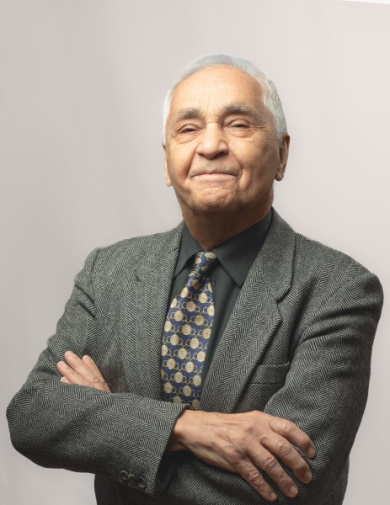
Composer, Professor, Honoured Artist of the Russian Federation, Honoured Artist of Ukraine, member of the Union of Composers of Russia, and musical public figure.
He was born in the settlement of Vladimirovka, Donetsk Region, Ukraine.
In 1960 he graduated from the Moscow Choral School, and in 1965 from the Composition Department of the Moscow Conservatory (composition class of Profs. S. S. Bogatyrëv and T. N. Khrennikov). In 1967 he completed the assistant‑internship at the Conservatory under the supervision of T. N. Khrennikov.
From 1967 to 1993 he worked as leading music editor at the publishing house Soviet Composer.
Since 1968 he has been a member of the Union of Composers of Russia; since 1989 a member of the Board of the Moscow Union of Composers and Chair of its Music‑Theatre Commission; and since 2006 a Secretary of the Union of Composers of Russia.
Since 1989 he has served on the editorial board of the journal Ballet.
In 2002 he spoke at the World Harp Congress in Geneva on «Music for the Harp in Russia».
Since 2004 he has been Chair of the Russian Harp Society (Moscow).
Since 1992 he has taught in the Instrumentation Department of the Faculty of Music Theory and Composition at the Moscow Conservatory.
Since 2013 he has also taught in the Department of Composition at the Gnesin Russian Academy of Music.
V. Kikta is the author of works in many genres. His output includes a number of ballets, symphonic works, oratorios and cantatas, instrumental concertos, choral works, compositions for organ and harp, music for children and young people, and much else.
Selected works include:
- Ballet Dubrovsky (1984);
- Ballet My Light, Maria! (1985);
- Ballet Saint Olesya (The Polish Sorceress) (1988);
- Ballet Vladimir the Baptiser (1997);
- Ballet Andrei Rublev (2016);
- Ukrainian Carols, Shchedrivkas, and Spring Songs (1967);
- Frescoes of Saint Sophia of Kyiv (1972);
- The Abduction of Europa (after the painting by Valentin Serov, 1990);
- Christ the Child Had a Garden, variations on a theme by P. Tchaikovsky (1989);
- Vladimir the Baptiser: A Symphonic Chronicle (1991);
- Oratorios and cantatas including Princess Olga (1970);
- Silent Starlight (1999);
- Piano Concertos Nos. 1 (1965), 2 (1979), and 3 (1986);
- Oboe Concertos Nos. 1 (1991), 2 (1996), and 3 (2000);
- Concerto on Scottish Themes of the Sixteenth to Eighteenth Centuries for Two Harps (2000);
- Works for organ;
- Works for harp;
- Choral works;
- Awakening, vocal cycle on texts by A. Pushkin (1972);
- Ukrainian Barcarolle for tenor, harp, and organ (2005);
- Works for orchestra of Russian folk instruments, including Smolensk Quadrilles (1975);
- Kulikovo Symphony (1979);
- Bylina of Vasilisa Mikulishna (1974);
- Russian Suite (1980);
- Belgorod Concerto for Oboe and Orchestra (1980);
- Chamber instrumental works;
- Music for theatre productions and films;
- Ballet films Dubrovsky (1985), Revelations (1992), and Mamenka (2003);
- Music for children and young people.
Recordings of V. Kikta’s music appear on numerous LPs and CDs.
The literature on V. Kikta is extensive, ranging from short press notices to substantial essays and book‑length studies.