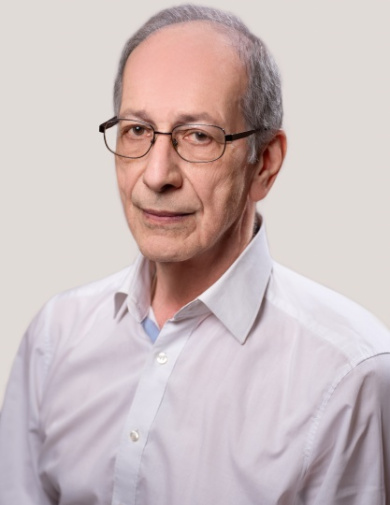
He was born in 1950 in Moscow. In 1976 he graduated from the Moscow State Tchaikovsky Conservatory, where he studied composition with Prof. Ye. K. Golubev and instrumentation with Prof. Yu. A. Fortunatov, and in 1979 he completed the postgraduate course at the Conservatory.
Since 1975 he has taught composition at the Gnessin State Musical College, and since 1989 he has taught in the Department of Composition and Orchestration at the Gnesin Russian Academy of Music, where he became a Professor in 2002.
In 1998 Andrei Golovin received the Moscow Government Prize in Literature and Art for his opera The First Love, staged at the Novaya Opera Theatre in Moscow, and in 2004, at the 15th Open Russian Film Festival Kinotavr, he was awarded the Mikael Tariverdiev Prize for Best Film Score for the feature film About Love directed by Sergei Solovyov.
His works include:
- the opera The First Love, after the novella by Ivan Turgenev;
- the ballet Bambi, after the tale by Felix Salten;
- four symphonies;
- the cantata Plain Songs, on texts by Nikolai Rubtsov;
- Eight Poems by Count Vasily Komarovsky for soprano and orchestra;
- Canto d’attesa for violin and orchestra;
- Canzona for cello and string orchestra;
- Two Songs without Words for chamber ensemble;
- Music for Strings;
- musical scenes after Bambi for soloists’ ensemble;
- a string quartet;
- chamber and vocal works;
- choral pieces;
- piano music.
In 2007 Golovin orchestrated Arnold Schoenberg’s cycle Brettl‑Lieder (Cabaret Songs) for voice and symphony orchestra, and in 2017 he orchestrated five songs by Nikolai Medtner for soprano and symphony orchestra.
His works have been performed by orchestras including:
- the State Academic Symphony Orchestra of Russia;
- the Tchaikovsky Grand Symphony Orchestra;
- the State Academic Symphony Capella of Russia;
- the Mariinsky Theatre Symphony Orchestra;
- the BBC Symphony Orchestra (UK);
- the Brno Philharmonic Orchestra (Czech Republic);
- the Rouen Conservatoire Symphony Orchestra (France);
- the Paris CRR Conservatoire Symphony Orchestra;
- the Moscow chamber orchestra Musica Viva;
- the string quartet Arpeggione (France).
Golovin has collaborated with conductors and soloists such as Veronika Dudarova, Vladimir Verbitsky, Vladimir Fedoseyev, Valery Gergiev, Valery Polyansky, Igor Zhukov, Alexander Rudin, Olivier Holt (France), Misha Damev (Switzerland), Xavier Dulate (France), Yuri Bashmet, Maxim Fedotov, Alexander Golyshev, Mlada Khudoley, and Luana Pellegrineschi (Italy), and his music has been heard in Germany, Austria, Finland, France, Italy, the United Kingdom, Poland, Greece, and the USA.
Since 1994 he has appeared as a conductor of his own works; in 2004, in the Great Hall of the Moscow Conservatory, he conducted Nikolai Myaskovsky’s Concerto for Cello and Orchestra with Alexander Rudin as soloist.
In 2014 the Great Hall of the Moscow Conservatory hosted a Golovin portrait concert, at which the Tchaikovsky Grand Symphony Orchestra under the composer’s direction performed a number of his symphonic works, including the premiere of his Fourth Symphony Light Unapproachable.
Golovin’s works have been published by:
- Muzyka;
- Sovietsky kompozitor;
- Alphonse Leduc (France);
- Editio Supraphon (Czech Republic);
- Zen‑On Music (Japan);
- Musikproduktion Höflich (Germany).
Various works by Golovin have been recorded on LPs issued by Melodiya and Russkiy Disk, and on CDs released by Boheme Music, Arts and Electronics (USA), Cadenza (Germany), and Relief (Switzerland); Melodiya has also issued four author CDs, and in 2015 Toccata Classics (UK) released a disc of selected symphonic works by Golovin.
In 1998 and 2001 Golovin served on the jury of the Masterprize International Composers’ Competition (UK), and in 2005 he was a jury member for an international competition for new works for symphony orchestra organised by the Tchaikovsky Grand Symphony Orchestra.
In 2015 he was Artistic Director of the Tchaikovsky International Music Festival in Klin, and to date he has written music for seventeen feature films, television series, and theatre productions, including the feature film Corridor of Immortality (2017).
He is a laureate of the Moscow Government Prize.