
Tamila M. Dzhani-zade
Associate Professor of Music History Department
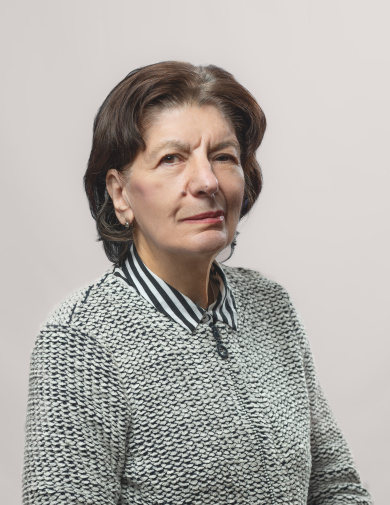
Biography
Researcher, teacher.
After graduating from the Kazan Music College (teachers R. S. Vayser, O. K. Yegorova, L. V. Brazhnik, Ya. M. Girshman, and others), she entered the Gnesin State Music and Pedagogical Institute (now the Gnesin Russian Academy of Music), which she completed with distinction in 1974 (special‑subject class with R. N. Berberov). The teachers who most shaped her professional interests included her favourite lecturers at the Institute (R. N. Berberov, F. G. Arzamanov, M. S. Bruk, R. K. Shirinyan, B. V. Levik, Yu. N. Rags, T. Ye. Leiye), as well as the musicologist and literary scholar M. G. Kharlap and the philosopher and cultural theorist V. M. Rozin.
During her studies at the Institute she was awarded a Lenin Scholarship and won several student research competitions.
In 1980 she completed her postgraduate studies at the Gnesin State Music and Pedagogical Institute and defended her Candidate dissertation at the State Institute for Art Studies (Moscow) on the topic «Azerbaijani Mugams: The Problem of Musical Thinking in the Art of Maqamat» (1983; supervisor F. G. Arzamanov), thereby defining the study of non‑European musical cultures as the principal focus of her scholarly work.
From 1974 to 2011 she worked as a research fellow at the M. I. Glinka All‑Russia Museum Association of Musical Culture. There she delivered a large number of lectures and developed a series of thematic lecture cycles («Eastern Salon», «Images of History in Music», the children’s club «Nine Muses», «Musical Geography», the «Musical Anthropology» Club, «Voices of Musical Epochs», and others). On the basis of the Museum’s collections she prepared and published the monograph «The Musical Culture of Russian Turkestan: Based on the Musical‑Ethnographic Collection of August Eichhorn, Military Bandmaster in Tashkent (1870–1883). A Catalogue‑Study», Glinka Museum, 2013, 336 pp.
She began teaching at the Gnesin Russian Academy of Music in 1992, creating new courses for musicology students: «Ethnomusicology» and «Musical Cultures of the Peoples of the World».
Since 2011 she has also taught courses in the history of Western music. Topics of graduation and postgraduate projects supervised by her include music of Iran, Lebanon, Sudan, Korea, India, Kazakhstan, and Western Europe.
T. M. Dzhani‑zade is a regular participant in international and All‑Russian scholarly conferences and orientalist seminars, both in Russia and abroad (more than fifty conferences).
Since 1989 she has been a member of the International Council for Traditional Music (UNESCO), and an active member of several of its study groups (Maqām Study Group; Study Groups on Folk Musical Instruments, on Musical Iconography, and on Historical Sources).
She was a participant and member of the organising committee of the international musicological symposia in Samarkand (1978, 1983, 1987).
In 2004 she undertook an art‑historical placement in Iran. In 2006 the CD «Classical Music of Iran: Ensemble Moulavi» was released, with an extended booklet essay.
As responsible editor and co‑author she has prepared the following collections:
- «Music in the Context of Islam: Traditions of Iran», in the series «Unity of Beauty: Islam and Music», vol. 1, Moscow, Sadra, 2019;
- «History and Anthropology of the Music of the Muslim World: Regional Traditions», «Unity of Beauty: Islam and Music», vol. 2, Moscow, Sadra, 2021.
T. M. Dzhani‑zade is the author of more than ninety publications, many of which have appeared abroad, including in Germany, Sweden, Denmark, Finland, the Netherlands, the United States, Iran, Jordan, Turkey, Azerbaijan, Uzbekistan, and Tajikistan.
Main research areas and selected publications:
- History, cultural studies, and typology of musical civilisations (for example: «The Poetics of Music in Islam: Towards an Understanding of Ritual and Music in Sufism», in Body, Object, Ritual, Institute of Oriental Cultures, RSUH, Moscow, 1996; «Azerbaijani Instrumental Mugams’ Features in the Context of Islamic Civilisation», in Maqam Traditions of Turkic Peoples, Berlin, 2006, pp. 57–75);
- Islamic music (for example: «Islamic Music», in the online encyclopaedia «Krugosvet», 2003; «Problems in the Development of Non‑European Musical Cultures», in Music: Survey Information, issue 2, Moscow, Informkultura, 1985, p. 23);
- Djani‑Zade, T., «Music of Azerbaijan», in Garland Encyclopedia of World Music, vol. 6, New York, 2002; «Music of Islamic Civilisation», Vestnik Rossiyskogo gumanitarnogo nauchnogo fonda, no. 1 (30), Moscow, 2003, pp. 156–169;
- Dzhani‑Zade, T., «The Current Usage of Historical Music‑Ethnographical Sources (A Study of an Unpublished Page from the Ethnographical Collection of Middle Asian Music in the Nineteenth Century by Military Bandmaster A. Eichhorn)», in Historical Sources and Source Criticism, ed. S. Ziegler, Stockholm, Svenskt visarkiv, 2010, pp. 289–306;
- «Soviet and Islamic‑Civilisational Layers in the Musical Culture of Azerbaijan», in Traditional Culture of Turkic Peoples in a Changing World, proceedings of the First International Conference (12–15 April 2017), Kazan, Ak Bure, pp. 135–138;
- «In the Footsteps of the Great Silk Road: Islamic Musical Classics of Uzbek and Tajik National Cultures and of the Sarts of Russian Turkestan», in Oases of the Silk Road: Current Issues in Ethnography, History, and Source Studies of the Peoples of Central Asia, Moscow, Marjani Publishing House, 2018; «Approaching the Musical History of Islamic Civilisation», Uchenye zapiski Rossiyskoy akademii muzyki imeni Gnesinykh, no. 4 (31), Moscow, 2019, pp. 88–95;
- Dzhani‑zade, T., «Discourse on Central Asian Music in the Ethno‑Cultural Context of Pre‑Soviet Times», in Folk Music Research, Folkloristics, and Anthropology of Music in Europe: Pathways in the Intellectual History of Ethnomusicology, eds. Ulrich Morgenstern and Thomas Nußbaumer, 2021; «The Musical Category Maqam in the History of Islamic Civilisation (Seventh–Seventeenth Centuries) and in the Post‑Civilisational Era», in History and Anthropology of the Music of the Muslim World: Regional Traditions, «Unity of Beauty: Islam and Music», vol. 2, 2021;
- Musical ethnography and comparative studies (for example: «The Ethnic Factor in the Culture of Islamic Civilisation: On the Turkic Musical Subculture in Islam», in Musical Culture in the Islamo‑Christian Context, Kazan, 2009; «The Concept of Radif in Azerbaijani and Persian Dastgah», in Proceedings of the Fifth Meeting of the ICTM Maqam Study Group, Samarkand, 2001, eds. J. Elsner and G. Jänichen, Berlin, 2010, pp. 41–66);
- From Musical Orientalism (for example: «Henry George Farmer and His Correspondence with V. M. Belyayev», Glinka Museum Yearbook, no. 2, Moscow, 2003, pp. 23–72);
- «Turning the Pages of M. G. Kharlap’s Archive», in Yearbook, vol. 4, Glinka Museum, Moscow, Kompozitor, 2013, pp. 490–502;
- «Reflections on the Concept of Maqam in Islamic‑Civilisational Culture: The Genesis of a Musical Phenomenon», Kultura i iskusstvo, no. 1 (31), Moscow, Nota Bene, 2016, pp. 11–24;
- With Li Jianfu: «Traditional Regional Features of Chinese Opera in the Musical Drama Baiju», Muzyka i vremya, 2017, no. 1, pp. 13–20;
- Tamila Dzhani‑zade, «Russia and Central Asia: Indigenous Music; Ancestral and Contemporary Practices», in The SAGE International Encyclopedia of Music and Culture, ed. Janet Sturman;
- «Ethnic, National, and Civilisational Identities in the Musical Culture of Pre‑Soviet and Soviet Central Asia», Uchenye zapiski Rossiyskoy akademii muzyki imeni Gnesinykh, no. 4 (35), Moscow, 2020, pp. 74–81;
- Musical theory, semiotics, and anthropology (for example: «Mugam as Mode‑Based Improvisation», in Contemporary Methods of Research in Musicology, Gnesin Institute Proceedings, vol. 31, Moscow, 1977, pp. 56–82; «Thematic Organisation of Mugam Improvisation», in Theoretical Problems of Non‑European Musical Cultures, Gnesin Institute Proceedings, vol. 67, Moscow, 1983, pp. 36–84; and numerous further works on maqam, canon, and performance practice);
- Organology (for example: «The Arabic ʿūd in the Musical Culture of Islamic Civilisation», in the online journal Issledovano v Rossii, 2002; «The Typology of Lutes in the Culture of Islamic Civilisation», in Anthropology of Culture, vol. 4, Moscow State University Institute of World Culture, 2010; expanded second edition in Voprosy etnomuzykologii, no. 1 (10), Moscow, Gnesin Russian Academy of Music, 2015, pp. 66–113; and Djani‑Zade, T., «The Organological and Iconographic Image of Turkish Lutes: On the Historical Plucked Instrument Qupuz‑i Ozan», in Studia instrumentorum musicae popularis XV, Stockholm, 2005).
The Gnesin Russian Academy of Music uses the «Digital Culture» subsystem to collect statistics. We make our website better and more efficient for users based on this data. By continuing to use this site, you agree to the use of cookies and data processing in accordance with the site's Policy on the processing and protection of personal data.