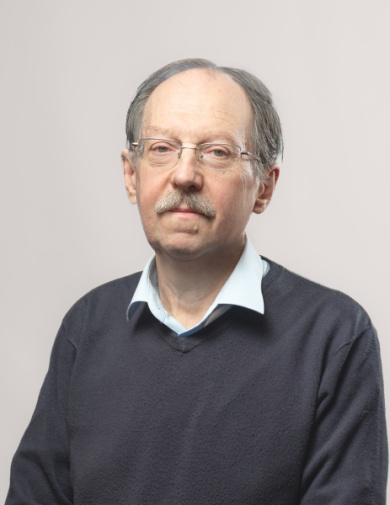
He was born on 24 March 1953 in the town of Polyarny, Murmansk Region.
In 1971 he graduated from the Gnessin Moscow Special Secondary Music School as a pianist (class of E. S. Kantorovich), and in 1976 he graduated with distinction from the Gnesin State Music and Pedagogical Institute with dual specialisations in composition (class of Prof. G. I. Litinsky) and piano (class of Assoc. Prof. L. Ye. Brumberg).
After completing his studies he continued for many years to develop his compositional craft under B. A. Tchaikovsky. From 1977 to the present (with a break in 1987–1992) he has taught composition at the Gnessin Moscow Special Secondary Music School. Since 1993 he has taught at Saint Tikhon’s Orthodox University of Humanities, where he is now a Professor and offers an optional course «Choral Writing in the Russian Orthodox Church» in the Department of Composition.
Since 2012 he has taught composition in the Department of Computer Music at the Gnesin Russian Academy of Music. His students include Metropolitan Hilarion (Alfeyev), A. Prishchepa, D. Trifonov, and others.
V. B. Dovgan is a laureate of the All‑Union Competition for Young Composers (1978), the All‑Russian Competition of Sacred Choral Music (2003), and other composition competitions.
Principal works:
- Opera The Moscow Conflagration;
- Choreographic scenes Caesar and Cleopatra;
- Oratorio Hear My Voice, O God in Memory of N. V. Gogol;
- Four symphonies;
- Five piano concertos;
- Concerto for double bass and orchestra;
- Symphonic miniatures;
- Two choral concertos – From the Lenten Triodion and Mountain Chants;
- Music for double bass, piano, and chorus;
- Two chamber cantatas;
- Trio for clarinet, double bass, and piano;
- Eight piano sonatas;
- Nine song cycles;
- Two string quartets;
- Two sonatas for oboe and piano;
- Sonatas for organ and bayan;
- Partita for harpsichord;
- Sacred music;
- Children’s music;
- Music for theatre and film.
Recent works:
- Cantata Christmas Songs for unaccompanied choir (2013);
- Oratorio Christmastide for soloists, choir, and orchestra (2014);
- Triptych on poems by M. Yu. Lermontov (2014);
- Clarinet Concerto (2015–2016);
- Fiery‑Winged Flower, a song cycle for folk voice and piano (2016), with a version for folk voice and folk orchestra (2017);
- Choral miniatures.
Dovgan’s works have been published, broadcast on radio and television, and performed at festivals, concerts, creative meetings, and symposia in more than twenty countries worldwide.
From 1980 to 1987 he served as Deputy Chair of the All‑Union Commission for Work with Young Artists under the Union of Composers of the USSR, and in the 1980s he was a member of the Artistic Council of All‑Union Radio and of the repertoire boards of the RSFSR and USSR Ministries of Culture.
From 1989 to 1991 he was Deputy Chair of the Repertoire Board of the USSR Ministry of Culture; from 1988 to 1990, Chair of the Board of the RSFSR Music Fund; in 1991, Chair of the festival committee «Moscow Autumn»; and from 1991 to 1992, Chair of the «New Works by Moscow Composers» Club at the All‑Union Composers’ House.
From 1987 to 1992 he served as Deputy Chair of the Board of the Moscow Union of Composers.
In the 1990s he was one of the leaders of the All‑Russian Seminar for Young Composers.
He has served on the juries of competitions including:
- The A. N. Scriabin Young Composers’ Competition (2002 and 2005);
- The competition marking the seventy‑fifth anniversary of the Tchaikovsky Grand Symphony Orchestra (2005);
- The Fourth All‑Russian Festival‑Competition named after A. Koshyts (2006);
- The International Competition «Muses of the World» (over a number of years);
- The Third International Composers’ Competition «Roman the Sweet‑Singer» (2015–2016).
He is a member of the Public Expert Council of the Moscow City Culture Committee (2005) and has led a sacred‑music workshop within the All‑Russian Seminar for Conductors and Composers «Choral Laboratory: Twenty‑First Century» (2014, 2015, 2016, 2017).
As a concert pianist he has appeared in many cities in Russia and abroad, including London, Cambridge, Vienna, Ghent, Potsdam, Berlin, Budapest, and others.
Performers of Dovgan’s works include:
- The Bolshoi Theatre Orchestra;
- The Tchaikovsky Grand Symphony Orchestra;
- The Symphony Orchestra of the USSR Ministry of Culture;
- The Moscow State Symphony Orchestra;
- The Russian Philharmonic Orchestra;
- The State Cinematography Orchestra;
- The Symphony Orchestra of the Berlin University of the Arts, and many other orchestras in Russia and Ukraine.
He has worked with conductors including V. Sinaysky, E. Khachaturyan, V. Ponkin, A. Katz, A. Lazarev, A. Vedernikov, K. Krimets, D. Liss, V. Yesipov, A. Chistyakov, S. Kogan (Russia), G. Baum (Germany), K. Matyukhin, G. Karapetyan, and S. Litvinenko (Ukraine), as well as many prominent Russian and foreign soloists.
Works available in recordings include:
- Piano Sonata No. 2;
- Sonata‑Rhapsody for bayan;
- Cantata The Miraculous Spring;
- Piano Sonata No. 8.
Dovgan’s compositions are published in Russia and abroad, as are articles and essays on his work, including entries in Grove’s music dictionary (UK).
Awards:
- Badge and letter of thanks from the Central Committee of the Komsomol and the Soviet Preparatory Committee «For active participation in the preparation and holding of the Twelfth World Festival of Youth and Students in Moscow» (1985);
- Certificate of honour and badge of the Cabinet of Ministers of Ukraine (1999);
- Medal of Saint Patriarch Tikhon, First Class (2012);
- Gold Medal of the Moscow Union of Composers (2013);
- Order of Saint Macarius, Third Class, of the Russian Orthodox Church (2013);
- Knight of the Imperial Order of Saint Anna, Third Class (2014).