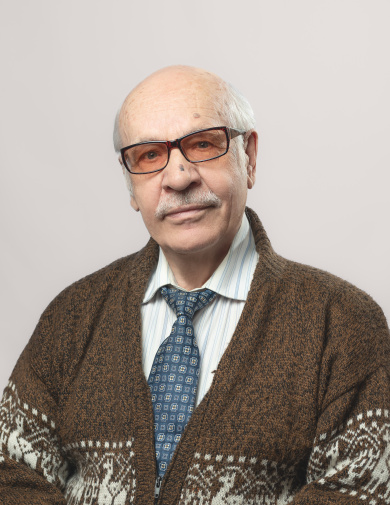
Vyacheslav Valeryevich Chistyakov is a Professor, conductor, Candidate of Psychological Sciences, public figure, author of numerous scholarly works (published in twenty‑two volumes), academician of the International Pedagogical Academy, and Honoured Art Worker of Russia.
His father was a prominent scholar, Professor and Doctor of Historical Sciences, and his mother was a physician.
He graduated from the Historical, Theoretical, and Composition Faculty of the Gnesin State Music and Pedagogical Institute (now the Gnesin Russian Academy of Music) in 1970 in the class of Professor Nikolai I. Peiko, and in 1973 from the Opera and Symphonic Conducting Faculty of the Ural Conservatory in the class of Professor, People’s Artist of Russia Mark Paverman. While studying in the theory faculty he spent five years in the orchestral conducting class of Professor, Honoured Art Worker of Russia Sergei G. Delitsiyev and also attended conducting classes on an elective basis at the Moscow Conservatory (with Lev M. Ginzburg and Kirill P. Kondrashin) and the Leningrad Conservatory (with Ilya A. Mussin and Natan S. Rabinovich); later he completed postgraduate studies in the Psychology Department of the Moscow Pedagogical State University, defending his dissertation in 1995.
Conducting career. After completing his studies Chistyakov worked for several years as conductor of symphony orchestras in Ukraine and undertook extensive tours with philharmonic orchestras in Samara, Altai, Tomsk, Odesa, Perm, Ulyanovsk, Yaroslavl, and other cities; over fifty‑five years he has appeared with around one hundred different orchestral ensembles—symphonic, wind, folk, chamber, and light‑music—and conducted some two thousand concerts. At the Y. A. Speransky Opera Studio Theatre of the Gnesin Academy he has conducted productions of «May Night», «Le nozze di Figaro», «La Bohème», and «La Traviata»; in the Moscow Experimental Music Theatre he has conducted «Eugene Onegin» and «The Queen of Spades» by Tchaikovsky and Poulenc’s «La voix humaine», and he has collaborated with the «Novaya opera» Theatre in Stravinsky’s «The Soldier’s Tale» and «Mavra» as well as symphonic works by Tchaikovsky and Rachmaninov.
In 1999 he conducted twenty‑three concerts with the European Symphony Orchestra in various French cities, including Paris, Marseille, Nice, and Clermont‑Ferrand. For twenty years he was Principal Conductor of the Youth Symphony Orchestra of the Central House of Arts Workers, training many future orchestral musicians, and has recorded DVD discs featuring works by Russian, Western, and contemporary composers; more than forty‑five positive reviews of his performances have appeared in the journals «Sovetskaya muzyka», «Muzykalnaya zhizn», and «Orkestr» and in the newspapers «Moskovskaya pravda» and «Rossiyskaya muzykalnaya gazeta».
Teaching. Chistyakov began teaching in 1967, first at the Music College named after the October Revolution (now the Moscow College of the A. G. Schnittke Moscow State Institute of Music) and then, from 1970 to 1973, at the Gnesin Music College. On returning to Moscow he joined the Military Conducting Faculty of the Moscow Conservatory in 1977 as a conducting teacher, and since 1980 has taught at the Gnesin Russian Academy of Music, where he became Associate Professor in 1987 and Professor in 2001.
Among his graduates are several People’s and Honoured Artists of Russia and many associate professors and professors at higher‑education institutions, while former international students now work as conductors in Germany, Spain, France, Italy, Ecuador, and South Korea. From 2002 to 2010 he also served as Professor in the Psychology Department of the Moscow Pedagogical State University, teaching courses in general, social, developmental, and educational psychology.
Scholarly, methodological, and public activity. Chistyakov is the author of numerous articles, methodological materials, and studies on the history and psychology of conducting, as well as orchestrations for various ensembles and two‑piano arrangements of classical repertoire; his six monographs include «Psychology of Conducting Activity», «From the History of the Art of Conducting in the 9th–10th Centuries», «Socio‑Psychological Aspects of Conducting Activity», and «The Joy of Creative Encounters with Great Conductors», together with a number of curricula for conducting students. In 2002 he was awarded the Grand Silver Medal «For Achievements in Education, Culture, and Science», and in 2007 received the title «Honoured Art Worker of the Russian Federation».
For twenty years he was Editor‑in‑Chief of the Gnesin Academy newspaper «Sovetsky muzykant» and co‑ordinator of research and methodological work in the Orchestral Conducting Department, provided methodological support to teachers at music colleges, and served as chair and jury member for numerous music competitions; he is also an academician of the International Pedagogical Academy.